
BSI Helps Bring National Attention to Local Construction Projects
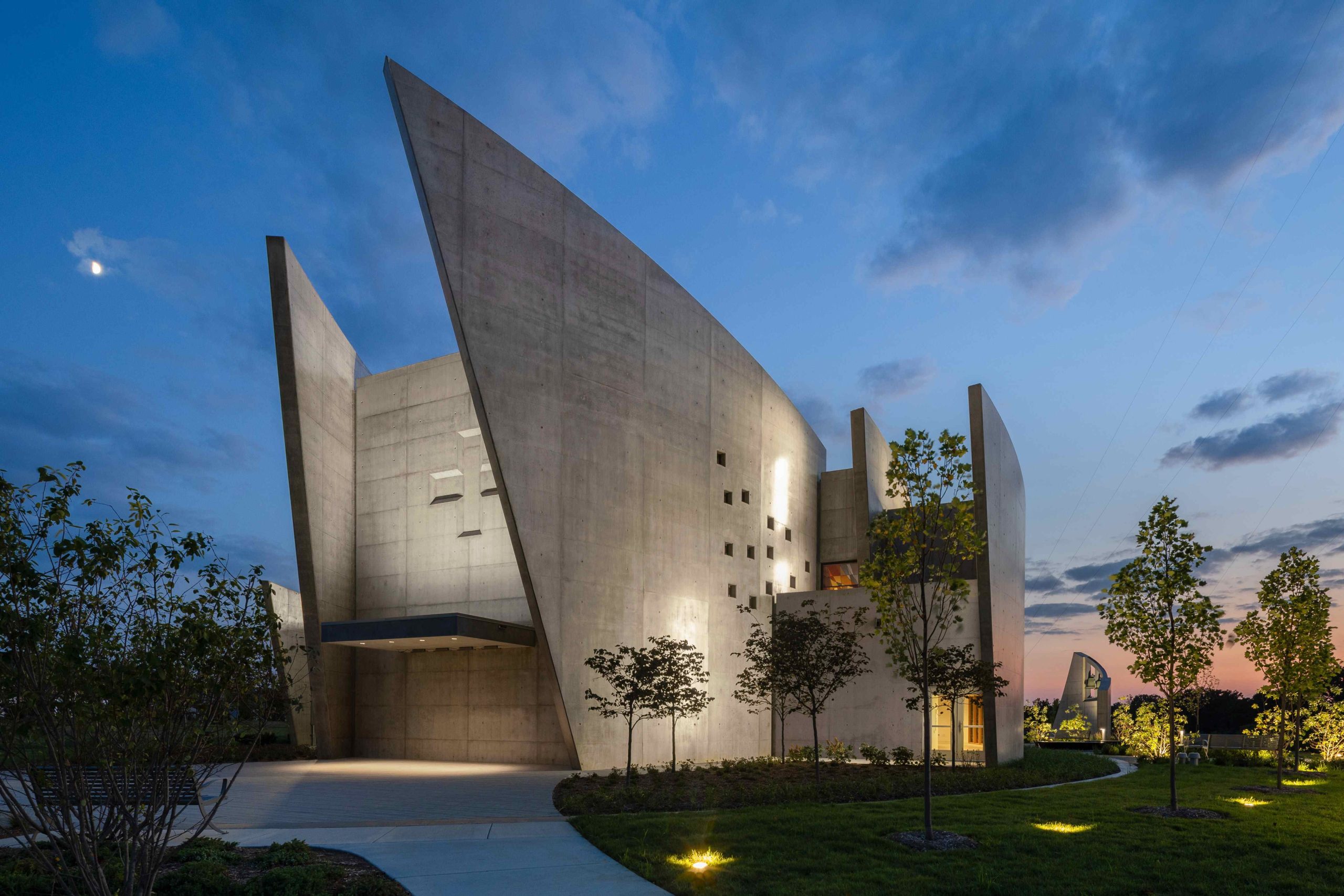
Images courtesy of BSI (above: Chapel of the Risen Christ at night)
By KERRY SMITH BUCK
America’s largest and oldest construction trade association, the Associated General Contractors (AGC) of America, held its annual convention in Orlando this past March. As it does each year, the association presents Baldwin Group “Build America” Awards to recognize, in the AGC’s words, “…the nation’s most impressive construction projects based on innovation, safety, state-of-the-art advancement and community impact” across building, highway and utility divisions.
With roughly 7,000 general contractor member firms and only 14 categories of awards dedicated to building construction, it’s very rare to win one of these awards. It’s especially rare for a firm to win two in the same year. But that’s what local general contractor BSI Constructors did this year.
“We had won national Build America awards twice before – in 2010 for Citygarden and in 2014 for the St. Louis Public Library’s Central Branch,” explained BSI President Paul Shaughnessy. “So, we were definitely pleasantly surprised to be recognized for two projects in the same year.”
The first of those was a Build America Merit award for the Jack C. Taylor Music Center in the Construction Management Renovation ($76 million to $125 million) category. Then the BSI project team was called up to accept the Build America award for the Chapel of the Risen Christ in the Construction Management New (under $20 million) category. The Chapel earned the additional distinction of being named one of three finalists for the National Project of the Year across all 30 categories and five divisions – building, civil, highway & transportation, utility and international.
Founded in 1972, BSI is headquartered in St. Louis and is owned by its employees including second and third generation family members of co-founder Joe Shaughnessy. “We focus almost exclusively on St. Louis area work, so we view national awards like these as well-deserved recognition for the level of skill and craftsmanship of St. Louis subcontractors and trade workers,” said Paul Shaughnessy. “In fact, of the awards that we have won, the American Subcontractors Association ‘General Contractor of the Year’ is probably the most meaningful because it’s the excellent trade partners we have on our teams that make it possible to deliver the quality required to win a Build America Award.”
“A Careful Act of Civic Choreography”
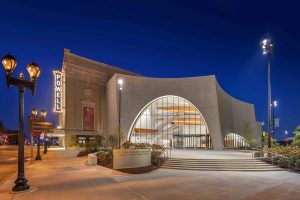
Even before receiving a Build America award, the Jack C. Taylor Music Center for the St. Louis Symphony Orchestra (SLSO) had already made its mark on the national stage. Not many ribbon cuttings in St. Louis (or the entire Midwest) are attended by a New York Times feature writer or grace the front page of the Times’ “Arts” section. Architectural Record also published a lengthy feature article on the project. Designed by Snøhetta, with Christner serving as Architect of Record, The Jack C. Taylor Music Center has been described as “A Careful Act of Civic Choreography.” It integrates a complete overhaul of historic Powell Hall (originally opened 1925) with a new 65,000-square-foot modern addition. The completed 125,000-square-foot facility places it in the upper echelon of the nation’s greatest concert halls. The architecture of the addition complements, but does not compete with, Powell Hall’s French Baroque features. Importantly it adds a welcoming entrance, an expanded lobby, modern backstage/rehearsal spaces, a music education center and major upgrades in patron amenities. Meanwhile, the existing Powell Hall underwent a complete overhaul with all new MEPF systems, demolition/reconstruction of seating area structures to improve legroom and ADA accessibility and scaffolding of the entire hall and lobby to enable cleaning, ornamental plaster restorations, gold leaf touchup and painting.
According to BSI Project Director Tim Hudwalker, “The New York-based project architect was very complimentary of the quality levels of the addition. He said it was much better than he was accustomed to on his New York projects. It’s a great credit to St. Louis trade workers that we were able to pull off the crazy geometry and unusual details so well. On the other hand, the goal of the renovation component was that, in spite of the major reconstruction, longtime Powell Hall patrons wouldn’t notice much difference after it was reopened, and that has been the case.”
One of the biggest concerns going into the project was whether Powell Hall’s legendary acoustics would be impacted by all of the changes. It was a big relief to everyone involved when SLSO Music Director Stéphane Denève proclaimed at the grand opening that the acoustics had actually improved.
“How Awesome is this Place”
Monsignor Dennis Delaney, Director of Catholic Cemeteries of St. Louis, had long dreamed of building a chapel of suitable size for funeral masses and prayer services that would also serve as a statement on the continuing role of the church in architecture and construction. It was a very ambitious vision that would need to be executed within a comparatively limited budget. Monsignor Delaney offered some examples of modernist church architecture as a source of inspiration, not duplication, to project architect St. Louis Design Alliance, which came up with a bold design concept that fulfilled his expectations. Its signature element was a configuration of nested, tall, radiused, upward sloping concrete walls and a ceiling with a dramatic upward swoop.
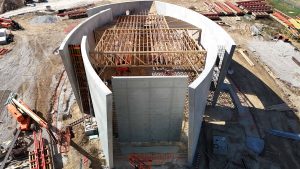
The challenge of how to build the structure fell to BSI. Project Manager Joe Shaughnessy III took the lead. Concrete is both the primary structural system and defining architectural element of the Chapel. As-cast architectural concrete is the most demanding of all surfaces. With virtually no post-placement surface treatment allowed (unlike coated, rubbed or sandblast finishes), you are “stuck” with what you see when the forms are stripped. On this project, the stakes were unusually high, as the desire for a monolithic (no horizontal or vertical construction joints) appearance was complicated by the sheer height of the walls, almost 51 ft tall in the extreme case.
In a panel discussion of National Project of the Year finalists in Orlando, Shaughnessy III was asked about the keys to project delivery on such a unique and challenging structure. “We knew that we were attempting something that had never been done before and that the precise outcome couldn’t be predicted. But the level of teamwork and mutual trust was off the charts. All three parties – Owner, Architect, Contractor – knew the other was sincerely working towards the best result so we could focus all efforts on that instead of defending our individual interests,” he said. In the end, the result exceeded all expectations. An excerpt from the owner’s dedication pamphlet reads:
When you come to the Chapel of the Risen Christ, the hope is that you will experience, in your minds and your hearts, the words of Jacob’s waking from his dream in Genesis 28:17: “How awesome is this place. This is none other than the house of God.”

To the question of how does a company go about winning a Build America award, Paul Shaughnessy reflected, “There’s no getting around the fact that it has to start with a demanding and dramatic project. No matter how well you execute, if the building itself doesn’t grab the attention of judges, your project won’t make the cut. So, we have to give credit to Snøhetta/Christner and St. Louis Design Alliance for their attention-grabbing designs. But we are especially grateful to the clients (Marie-Hélène Bernard of the SLSO and Monsignor Delaney of Catholic Cemeteries) who support innovative architecture and construction, and who placed their trust in BSI to deliver the vision.”

View Our Latest Print Edition

Fresh Content
Direct to Your Inbox

YOUR RESPECTED INDUSTRY VOICE
Join CNR Magazine today as a Content Partner
As a CNR Content Partner, CNR Magazine promises to support you as you build, design and engineer projects across the U.S.
CNR is equipped and ready to deliver a dynamic digital experience paired with the top-notch, robust print coverage for which you’ve known and respected us for since 1969.