
The New Jobsite Partner: Why Robotics Is Ready for Its Breakout Moment
By MATT SMITHMIER
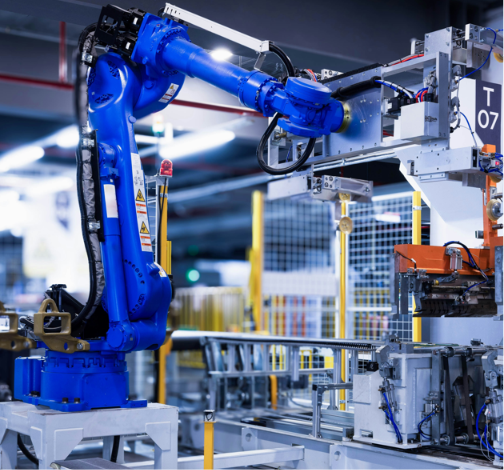
While The Jetsons universe of flying cars and robot housemaids has yet to come to fruition, the field of robotics has nevertheless made dramatic leaps forward in the past decade — and the construction industry is starting to reap the benefits.
From autonomous mobile robots and robotic exoskeletons to drones and AI-powered inspection robots, the latest innovations are already reducing errors, improving safety and increasing the speed of projects.
Erol Ahmed is vice president of communications with Built Robotics and says this kind of progress is certainly nothing new.
“Construction has been defined by new technologies for the past century,” he said. “These things have come every decade, and they just make us build better and faster.”
The San Franciso-based company specializes in robots that automate repetitive tasks in the $300 billion solar industry, including a pile-driving robot that can handle around-the-clock foundation installation on solar farms. Ahmed says solar is a perfect fit for robotics and automation, especially as the rise of artificial intelligence and data centers necessitate the need for huge amounts of electricity.
“It’s one of the few construction tasks that’s incredibly consistent and repetitive,” he said. “Solar was made for automation. Plus, the demand is coming from all sorts of industries. We need a lot of electricity. There’s a lot of consumer and industrial demand, paired with growing labor shortfalls.”
In fact, that supply vs. demand issue might just be where robotics can serve the greatest purpose. Associated Builders and Contractors estimates the industry must attract 349,000 new workers this year just to meet demand as construction spending growth is set to expand. Ahmed sees robotics as the perfect solution to fill that gap.
“Even if 100,000 people sign up for the job today, it takes two to three years for them to become proficient,” he said. “Whereas a robot has a hive mind; it works just as well as all the previous robots combined.”
Vineet Kamat, PhD, FASCE, NAC, is a professor in the College of Engineering at the University of Michigan and also serves as vice president of publications for The International Association for Automation and Robotics in Construction (IAARC). The global organization of academic researchers in construction robotics works to encourage and promote new technical development in the field, while assisting end-user application in the field. Its members conduct research and develop innovations and publish their findings, and several of the research outcomes are then translated into commercial products for the construction industry.
Karmat says the industry is already benefitting from robotic advancements in offsite construction, where modular sections and prefabricated construction components can be built more quickly and at a higher quality.
“These components are then transported to construction sites and rapidly assembled, reducing the overall time, cost and labor,” said Karmat. “Advancements in machine learning and AI are having a dramatic effect on the industry lately because we can develop smarter automation and robotics solutions, where both our computer systems and analysis tools (as well as physical robots) can be more adaptive and intelligent and learn from experience.”
Of course, in addition to filling workforce gaps, robotics in construction can also improve safety on the jobsite by automating dangerous, physically taxing and highly repetitive tasks. Drones are a good example of a technology that’s already made a measurable impact: Inspection robots in confined spaces, for example, can maneuver into small or even dangerous areas, like underground tunnels or areas with hazardous chemicals.
Now, a company based in Switzerland is working to use the technology for new applications.
Born from a university research project, Aithon Robotics recently produced a drone that can not only perform inspections but also evaluations, sensor installation and core sampling of concrete assets, tasks that are especially useful on large civil infrastructure assets (think highway bridges, tall chimneys, etc.). This eliminates the need for scaffolding, ropes and putting humans in some quite dangerous and precarious situations.
“Every minute spent by a human working at height is in some way dangerous,” said Roman Dautzenberg, Aithon Robotics CEO and co-founder. “The people working in these jobs, they are real superheroes and they take a lot of pride in the type of work they’re capable of doing. But it’s still very tough, strenuous work and inherently dangerous work. The drone definitely has a huge safety potential there.”
While Aithon is still young and yet to break into the U.S. market, the feedback from companies in Europe has been overwhelmingly positive, Dautzenberg says, and they’re already working on what’s next.
“We always say we want to combine human capability with aerial mobility,” he said. “And basically, the opportunities are limitless.”
“Limitless” does seem to be the consensus of those working most closely in the field. Kamat says the construction industry is not far off from humans and robots working side by side.
“Intelligent construction robots in the coming years will be capable of serving as ‘tireless’ assistants to construction workers, making it possible for people of all skills and physical capabilities to work in the construction industry,” he said.
And even though we’re not there yet, Ahmed says he’s just excited to be a part of this next chapter in the industry.
“I think construction hasn’t had this moment in maybe a hundred years,” said Ahmed. “It’s going to be fun.”

View Our Latest Print Edition
Fresh Content
Direct to Your Inbox

YOUR RESPECTED INDUSTRY VOICE
Join CNR Magazine today as a Content Partner
As a CNR Content Partner, CNR Magazine promises to support you as you build, design and engineer projects across the U.S.
CNR is equipped and ready to deliver a dynamic digital experience paired with the top-notch, robust print coverage for which you’ve known and respected us for since 1969.