
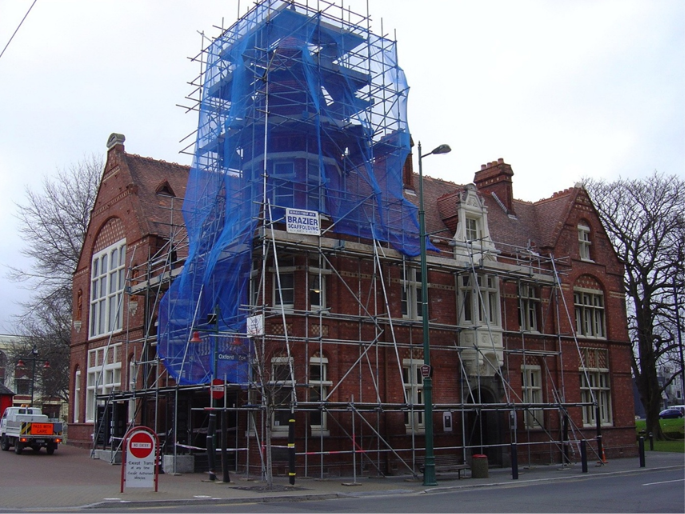
Rehabilitation of Christchurch Municipal Chambers, used by Christchurch City Council as it civic offices from 1887 to 1924. The Category I heritage building is registered with Heritage New Zealand. (Photo courtesy of Murray G. Miller)
Historic Preservation Matters That Can Impact Your Construction Project
By MURRAY G. MILLER
Historic preservation is an important part of the construction industry.
One may be inclined to think of it in physical or “bricks and mortar” terms.
However, historic preservation is much broader. Essentially, it is a Conversation with Our Past about Our Future. It is less about freezing a historic structure in time, preventing change or the museumization of architecturally impressive properties than it is about the management of change — of buildings, districts, objects, sites, landscapes, structures and places.
Admittedly, managing change often requires planning and due diligence. For brevity, let’s consider a few historic preservation matters you may have experienced, starting with ensuring there is clarity regarding the historic status of a property.
Myth: A National Register-listed property has so many restrictions that it can’t even be painted.
The National Register of Historic Places is the official list of the nation’s historic places worthy of preservation. If you are working on a National Register (NR) property, there are no restrictions for private property owners, except in circumstances when federal funds are used or federal permits are required. When federal funds are being used on a project, it can trigger a review path known as the Section 106 Process. Section 106 of the National Historic Preservation Act of 1966 (NHPA) requires federal agencies to consider the effects on historic properties by the projects they carry out, assist, fund, permit, license or approve throughout the country.
If the Section 106 Process is unaccounted for as due diligence at the front end of a project, the process can impact your construction scheduling due to the need for consultation with the State Historic Preservation Office, Tribal Historic Preservation Office and any affected parties.
Terminology: We’ll repair the historic property and construct an addition as part of the restoration project.
The construction industry is well equipped with terms and terminology. So, too, is historic preservation. If your historic building project involves an addition, then it cannot be a restoration project. In the U.S., there are four treatments used to manage change that may impact historic properties — preservation, restoration, rehabilitation and reconstruction. An addition is provided for under the treatment known as rehabilitation.
Rehabilitation is the act or process of making possible a compatible use for a property through repair, alterations and additions while preserving those portions or features that convey its historical, cultural or architectural values.
Restoration is the act or process of accurately depicting the form, features and character of a property as it appeared at a particular period of time by means of the removal of features from other periods in its history and reconstruction of missing features from the restoration period.
If there is any uncertainty as to which treatment is being applied, this could affect the pre-project planning and documentation; design; preconstruction and permitting; demolition and removal; construction, finishing and detail work; and inspection, certification and closeout stages. That represents a considerable opportunity for impacts on your construction schedule. As I often say, “Clarity is our friend.”
Significance: These two properties from 1934 are historic and we’ll be saving those, but the ones that were built in the 1960s can’t be historic – so they will be demolished as outlined in our pre-project planning and documentation.
Age itself is not typically a determining factor as to whether a property is significant; however, there is generally a 50-year rule-of-thumb that triggers a property’s eligibility for evaluation against criteria often adopted by local, state or federal agencies. The NR Criteria for Evaluation relate to the quality of significance in American history, architecture, archeology, engineering and culture that is present in districts, sites, buildings, structures and objects and that possess integrity of location, design, setting, materials, workmanship, feeling and association. The NR criteria are associated with significant events, persons, distinctive characteristics of a property or properties that have yielded – or may be likely to yield – information important in prehistory or history.
In many cases, if a structure is not individually listed, it may be part of an historic district that has group value. If a property is not individually listed but has been identified as a contributor to a NR-listed or deemed eligible historic district, then the individual property has important status as an historic property.
It is therefore of critical importance to have clarity as to whether your project involves historic properties that are at least 50 years old and whether they have been evaluated against applicable criteria. Failure to do so at the front end of a project could impact your construction schedule.
Character-Defining Features: On a street with traditional shotgun houses, we plan to remove the front porch of this 1921 shotgun house and rebuild it with the house set on a slab-on-grade foundation to restore its historic character.
Typically, a historic shotgun house would have been constructed on a pier and beam foundation, and the house would have been elevated to separate it from the public street and to provide for a projected outdoor sitting space that afforded opportunity to socialize among neighbors. This important aspect is what is referred to as a “character-defining feature.”
A proposal to set the house and porch at grade would be inconsistent with preservation principles because it would affect its character and relationship to the existing traditional houses along the street. If the site planning and overall character are not carefully considered up front, it could delay approvals and therefore impact your construction schedule.
Context: We’re just using the same plan that was approved last year for a lot in a different neighborhood. If it was approved last year, it should be approved this year.
If you have an opportunity to construct a new building on a vacant lot that is within an historic district, that street and the buildings around it will likely contribute to certain characteristics. It will be important to clarify which buildings have been identified as “contributing” properties around the vacant lot and along the street. Any new construction within a historic district will need to have regard for the predominant traditional character and appearance of the historic district for it to be considered “compatible” with its historic context. Compatibility does not mean replication – and if your plans have not been designed with context in mind, it could impact your construction schedule.
There are many ways that historic preservation due diligence can impact your construction schedule. Aim to minimize these possible challenges, since there will likely be other challenges appearing on the construction scheduling horizon.
Murray G. Miller is the historic preservation manager at Cushing Terrell.

View Our Latest Print Edition

Fresh Content
Direct to Your Inbox