
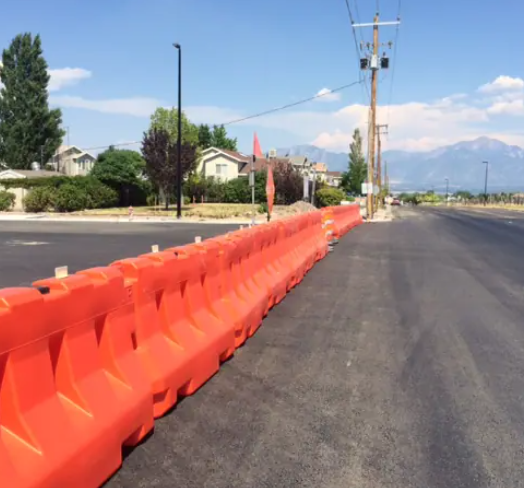
Why Outdated Barriers Are Still Putting Crews at Risk
By ARCHIE SCOTT III
Every spring, drivers are told to slow down and watch for work zones.
That message matters, but awareness alone is not enough. Reducing deaths and serious injuries also requires stronger physical protection between traffic and road crews.
NHTSA says distracted driving claimed 3,208 lives in 2024.
The agency also warns that sending or reading a text takes a driver’s eyes off the road for 5 seconds, at 55 mph, that is like driving the length of a football field with your eyes closed. In work zones, that danger becomes especially acute. The National Safety Council, citing FHWA data, says 857 people were killed and 44,240 were injured in work zone crashes in 2020.
That should force a harder question: if we know distracted, speeding or impaired drivers will continue to enter work zones, are we consistently using protection systems designed for today’s traffic conditions?
Too often, the answer is no.
Many work zones still rely on legacy barrier systems, or – in some cases – on cones, drums and other channelizing devices where crash-tested physical barriers would better protect crews. That gap matters because vehicles are heavier than they used to be, speeds remain high and roadside safety standards have changed for good reason.
The Federal Highway Administration states that new roadside safety devices seeking federal aid reimbursement eligibility must be crash tested under AASHTO’s Manual for Assessing Safety Hardware (MASH). For many work zone applications, that means MASH Test Level 3, which evaluates performance at speeds up to 62 mph using a modern test matrix that includes a high-center-of-gravity pickup truck and a small car.
That represents a meaningful departure from the older standards many barriers were originally designed to meet. Under the current MASH framework, the pickup test vehicle weighs 5,000 pounds and the small car weighs 2,420 pounds, and the required impact angle is more severe than in prior legacy testing. The result is a more realistic evaluation of how barriers perform in the kinds of crashes work zones face today. As the vehicle’s fleet have grown larger and heavier, barrier performance standards have had to keep pace.
The challenge is that replacement has not moved uniformly. Some owners and agencies are proactive. Others are slower to phase out damaged, outdated or non-compliant systems. On the road, that can mean crews are working behind barriers designed to older criteria, barriers with visible wear and damage or barriers installed in ways that do not match the level of protection the job actually requires.
That should concern everyone in the project chain. A barrier is not just a procurement item; it is a life-safety system. If a worker is operating only a few feet from traffic, details like deflection, debris, anchoring and crash performance are not technical footnotes. They help determine whether that worker goes home safely.
Modern barrier systems should be judged not only on whether they meet current crash conditions, but also on whether they make positive protection more practical to deploy. That is where innovation matters. Newer systems built with advanced materials and modern engineering can do more than meet updated crash criteria. They can also reduce the transportation, handling and installation burdens that have historically caused contractors to minimize or avoid positive protection. Lighter systems can reduce freight demand, reduce handling risk and speed up installation, meaning crews get behind a protective wall faster.
That has been a central focus in our own work at Asynt Solutions. We developed the Ape Barrier®, a composite barrier system designed to absorb and dissipate crash energy while avoiding the brittle breakage and debris hazards that can come with older materials. Based on internal test and product data, the system has shown more than a 22 percent reduction in the G-force experienced by an impacting driver compared with traditional concrete barrier benchmarks, while also producing no dangerous barrier debris during impact.
Deployment matters, too. On one recent Ohio installation, about 504 feet of barrier was delivered on a single truck, and the contractor installed the barrier and four attenuators before lunch using a skid steer rather than the heavier equipment typically associated with concrete barriers. That speed means less exposure during setup and a faster move to protection.
So, what should contractors, DOTs and policymakers do differently in 2026?
- Accelerate the phaseout of outdated barrier inventories. If a system was designed around older criteria, agencies should have a clear transition plan.
- Inspect barrier condition more rigorously. Damaged units should not remain in service simply because replacement is inconvenient.
- Specify for the actual work zone. If crews are working close to traffic, low-deflection performance and proper anchoring should be prioritized.
- Evaluate full-life safety and efficiency, not just upfront cost. A barrier that is easier to transport, faster to install and safer in impact can create value well beyond its purchase price.
- Treat positive protection as essential infrastructure. Cones and drums have their place, but they are not a substitute for crash-tested worker protection where intrusion risk is real.
The industry has done a good job telling drivers to pay attention. It now needs to do a better job making sure the protection deployed in work zones reflects the traffic realities of 2026, not 1996. Work zone crews cannot choose their office. Their office is the roadside. The least we can do is make sure the barrier standing between them and a distracted driver is worthy of that responsibility.
Archie Scott III is founder and CEO of Asynt Solutions.

View Our Latest Print Edition

Fresh Content
Direct to Your Inbox